Dashboard IoT Real Time – Proof of Concept
Experimental project developed to explore real-time interfaces, advanced data visualization, and integration with connected IoT systems.
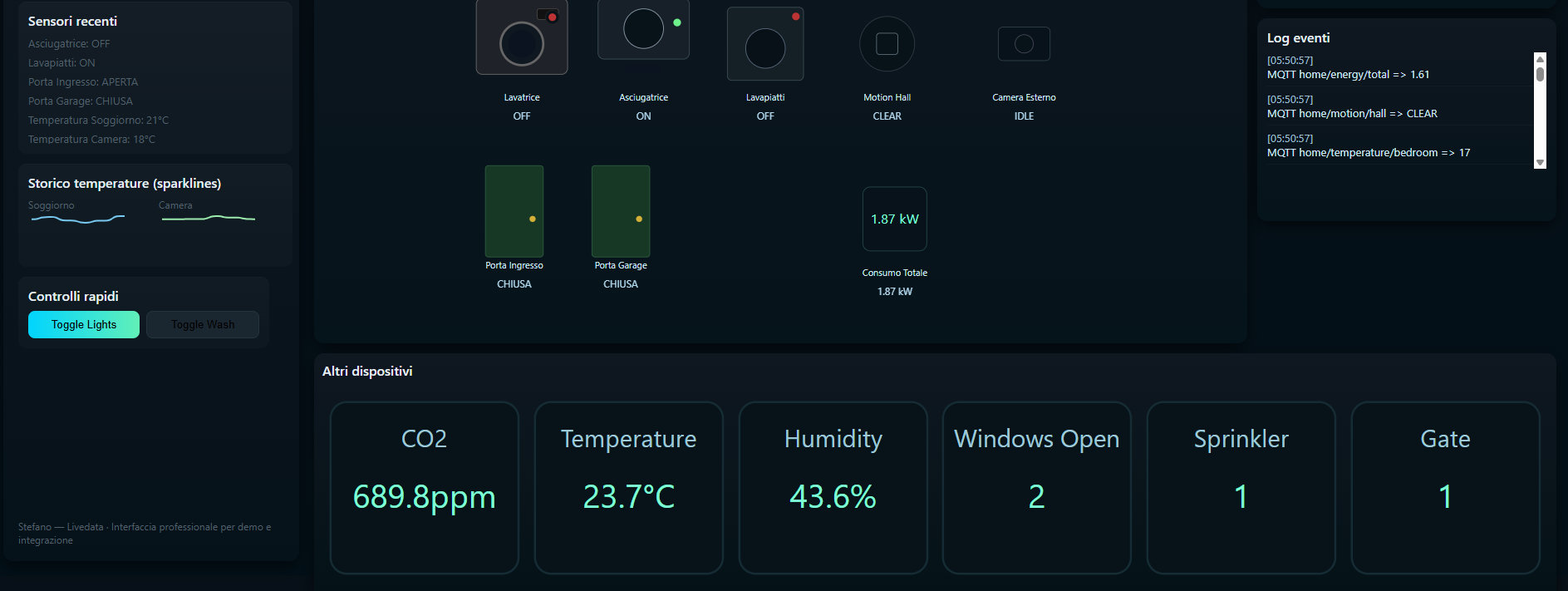
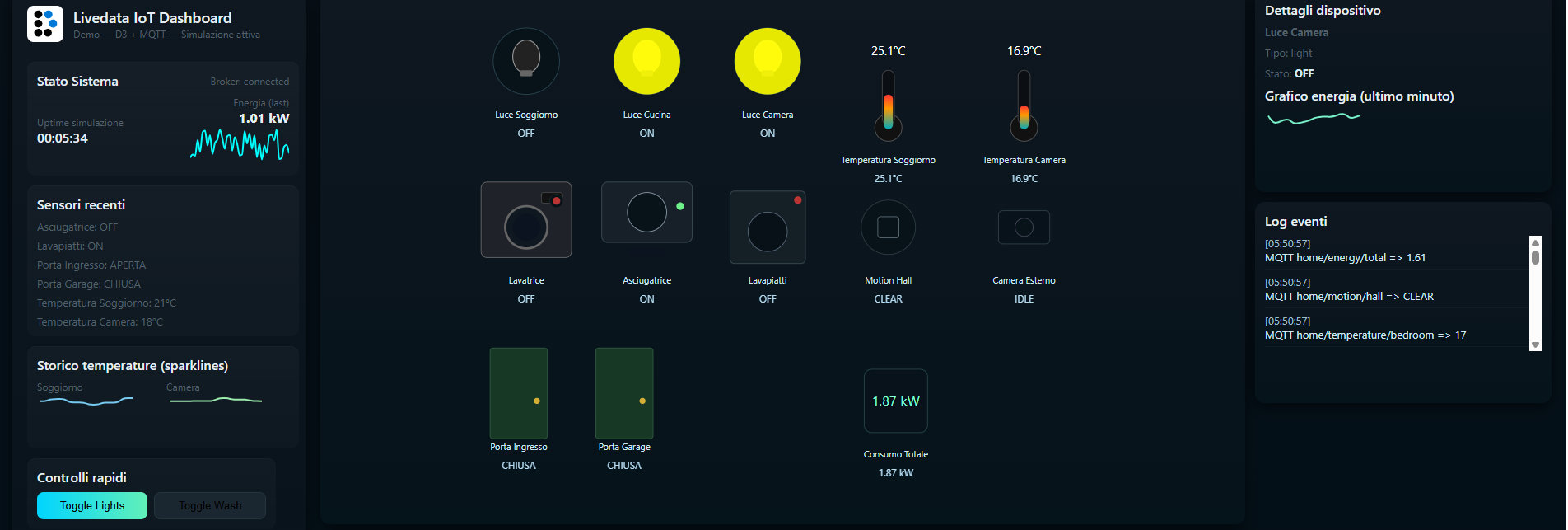
The dashboard simulates a smart home environment in which virtual devices communicate via asynchronous flows, with statuses and data updated in real time and represented through interactive SVG graphics created with D3.js.
Each element of the system—lights, appliances, temperature and motion sensors, video cameras, and energy meters—is modeled as a dynamic node, equipped with status, contextual animations, and event logs, to offer a clear and immediate representation of the system's behavior.
Architecture and technologies
The project adopts a modular architecture, designed to be easily extendable:
-
Frontend
-
Modern JavaScript (async / event-driven)
-
D3.js for data visualization and dynamic SVGs
-
Smooth and contextual animations
-
Responsive UI, designed for operational dashboards
-
-
Backend / Integration
-
PHP as a security layer and proxy Application
-
Server-side credential management
-
Real-time data simulation and polling
-
-
Communication
-
MQTT protocol (publish / subscribe)
-
Support for secure WebSockets (WSS / HTTPS)
-
Framework compatible with real brokers and industrial systems
-
-
Infrastructure
-
Cloud infrastructure
-
Attention to security, isolation, and continuity of the service
-
Objectives and possible applications
This project was born as a proof-of-concept, but is conceived as a concrete basis for:
-
IoT dashboard and smart buildings
-
Energy and environmental monitoring
-
Industry 4.0 systems
-
Operational interfaces for hotels, ports, production plants
-
Control panels for connected infrastructures
Thanks to its modular structure, the dashboard can be Easily extendable with:
-
Real MQTT flows
-
External APIs
-
Authentication systems
-
Historical data storage
-
Integrations with industrial or cloud platforms
Project Value
This demo demonstrates a pragmatic and product-oriented approach, combining advanced front-end, data visualization, and back-end integration skills, with a focus on security, scalability, and user experience.
A concrete example of how complex projects can be translated into clear, responsive, and professional interfaces.