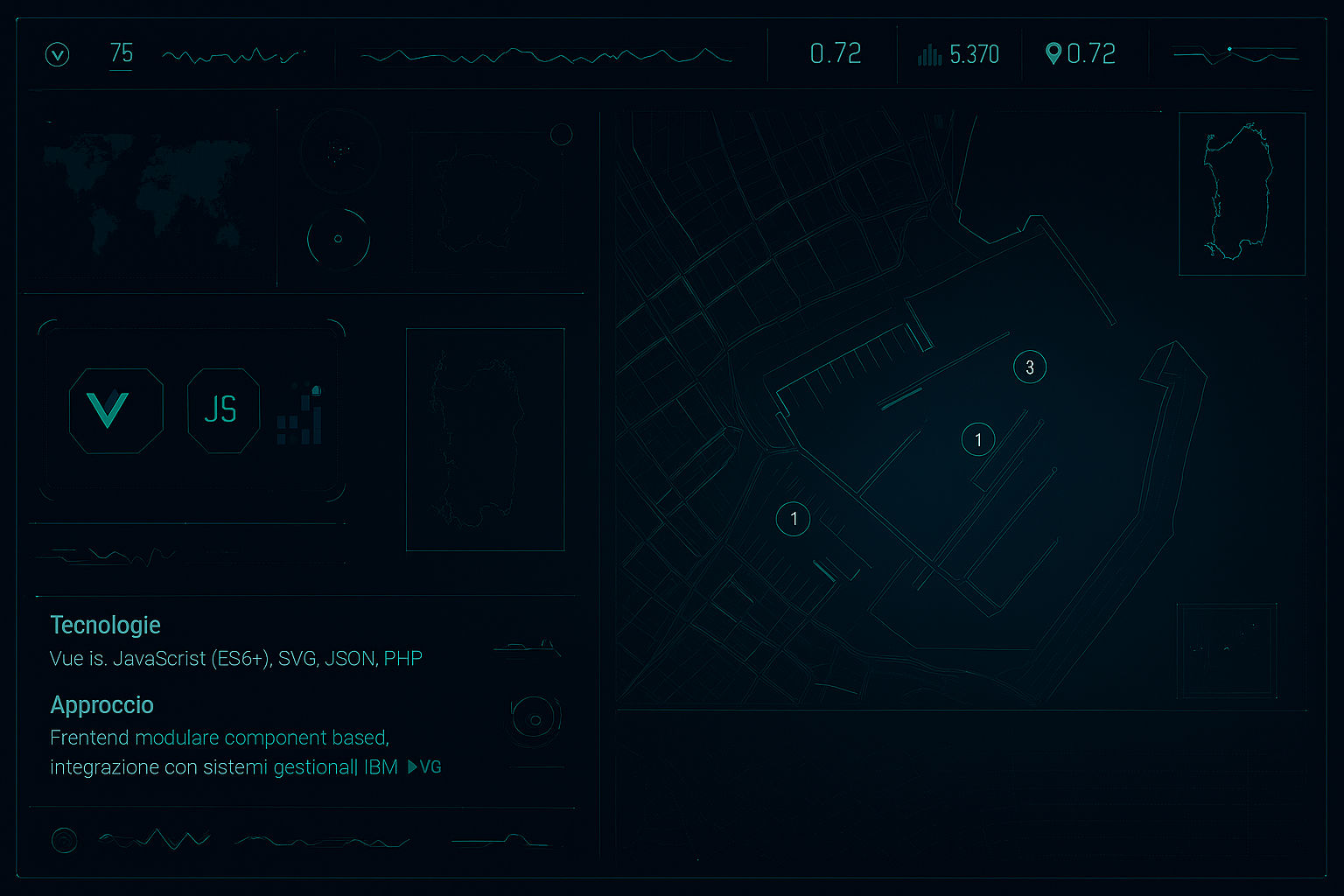
Ports in Sardinia Web App
We collaborated with a major industrial group to develop a web app dedicated to the operational management of six tourist ports in Sardinia, including Marina di Porto Rotondo, Portus Karalis, Porto Marana, and Calabitta.
The project's goal was to create a modern, fast, and highly usable interface that could integrate with the client's existing management infrastructure.
Modern and Component-Based Frontend
The application's front end was developed with Vue.js, adopting a completely component-based approach.
This architectural choice allowed us to:
-
create a modular, scalable, and easily maintainable interface;
-
implement functionality advanced interactive features;
-
Ensure fast response times thanks to asynchronous communications with the backend.
The app communicates with server-side services via JSON-based APIs, using JavaScript to manage asynchronous requests and dynamically update the user interface.

Integration with the group's IBM CRM/ERP
One of the most significant aspects of the project is integration with the IBM management system used by the group.
This integration allows:
-
Real-time data synchronization;
-
Automatic updating of mooring, contract, and service information;
-
Reduction of operational errors and duplicate procedures.
The interface adapts to existing workflows, improving efficiency without modifying the existing backend infrastructure. Operational.
Interactive Port Maps based on SVG
The web app includes an advanced system of interactive port maps, created with SVG technologies and powered by dynamic JSON data.
The maps allow operators to:
-
view the layout of berths;
-
identify berth availability in real time; of moorings;
-
Quickly access information associated with each berth;
-
Manage operations and assignments visually and immediately.
The use of SVG guarantees precise, resolution-independent graphics, ideal for complex structures such as marinas.
API Architecture and Asynchronous Communication
The application uses JavaScript-based asynchronous communication to:
-
update specific sections of the interface without reloading the page;
-
receive data in real time;
-
maintain a fluid user experience even when processing large amounts of information.
This "API-first" architecture makes the system flexible and easily expandable to other future services.
Collaboration with the Group's IT Team
The project represented an important opportunity to collaborate with the industrial group's IT team, composed of highly qualified professionals in the development of management systems and complex technical infrastructures. The application's backend was developed directly by their IT department, with whom we worked in full synergy to effectively integrate APIs, operational flows, and pre-existing business logic.
This collaboration allowed us to combine complementary skills—on the one hand, the client team's experience in IBM architectures and internal processes, on the other, our specialization in the design and development of modern interfaces—contributing to the project's success and the creation of a solid, scalable solution perfectly aligned with the operational needs of tourist ports.